
A strange protective suit in a Brussels museum cabinet tells the story of the flooded Belgian front in the First World War — and of what happens when water, engineering, disease and defence become impossible to separate.
Image: AI generated from a photo by Ashley Morgan, taken at the Brussels Air Museum, 12 September 2026.
I went to the Brussels Air Museum because my daughter was working on a school project. As often happens in museums, however, the object that stayed with me was not the one I had gone there to see.
Standing in a cabinet was a strange, almost otherworldly protective suit: heavy, enclosed and fitted with a hood and viewing lenses. It looked, at first glance, more like something designed for another planet than for Belgium. Then I read the accompanying display. The suit belonged to the story of the flooded Belgian front during the First World War — a landscape in which warfare, water management, engineering and human health became tightly intertwined. And more than a century later, I think there is still a One Health lesson in it.
When the landscape became part of the defence
In October 1914, the Belgian Army was under enormous pressure along the Yser. The low-lying polder landscape around Nieuwpoort contained a sophisticated network of drainage channels, sluices and waterways, centred on the Ganzepoot sluice complex, where six waterways converge. Rather than simply accepting the landscape as it was, the defenders changed it.
By manipulating the sluices around Nieuwpoort at high tide, seawater was gradually allowed into the Yser plain, and after two insufficient attempts a broad flooded zone had developed by 29 October between the Yser and the Nieuwpoort–Diksmuide railway embankment. The inundation helped halt the German advance and contributed to stabilising this part of the Western Front.
But creating the flood was only the beginning. The inundation had to be actively maintained for years — sluices, embankments and waterways required constant inspection and repair under wartime conditions, work overseen by the Belgian army’s engineer corps and, from 1915, a specialist unit, the Compagnie des Sapeurs-Pontonniers. The flooded zone itself also had to be crossed. The museum’s own display panel describes patrols equipped with rubber suits carrying out raids on advanced enemy posts across water that was never meant to be crossed on foot. That was the context in which equipment such as the suit in the cabinet became essential.
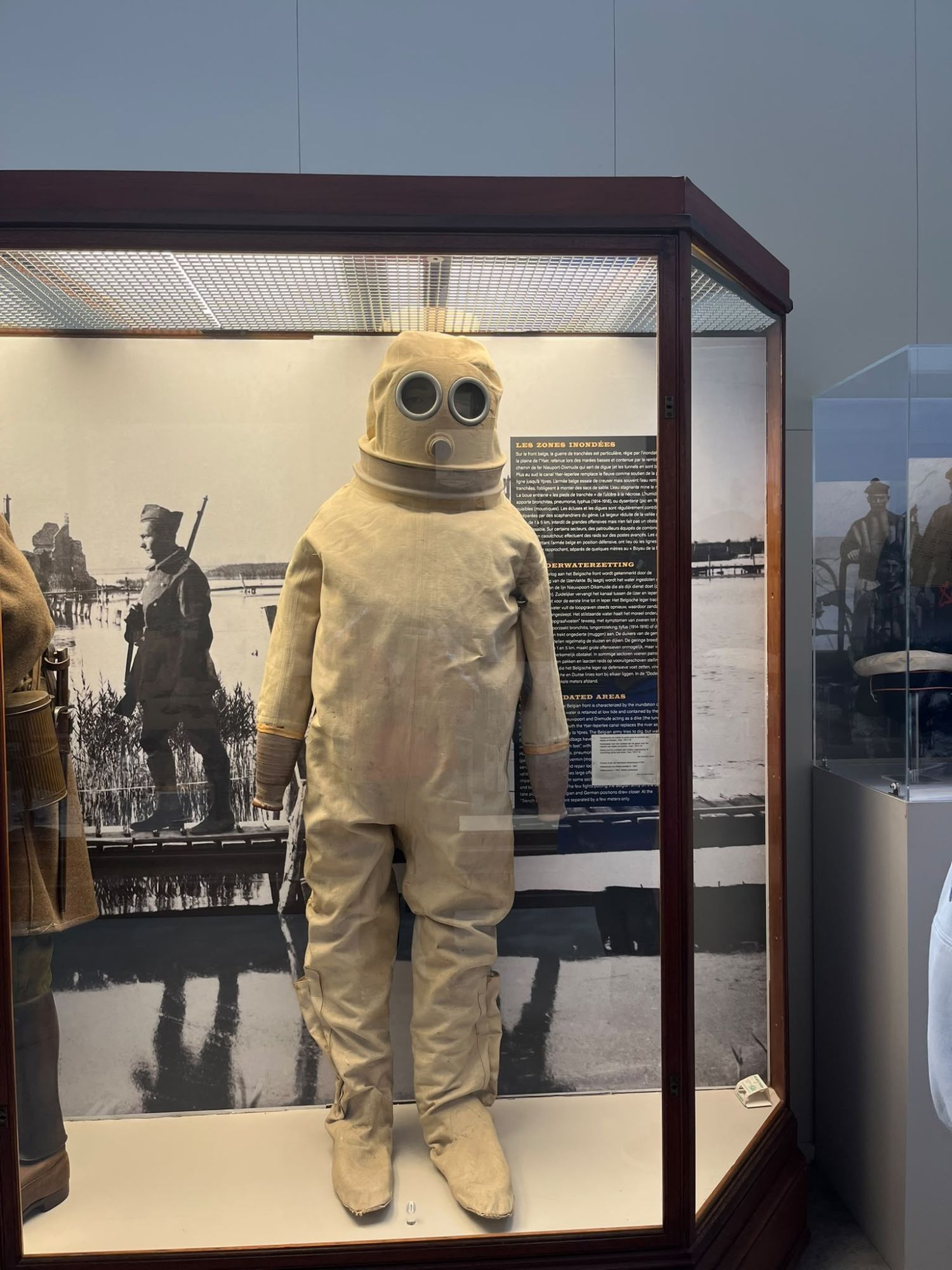
Water stopped an army. It also transformed the health environment.
Flooding may have provided a military barrier, but it did not create a sterile one — it created a radically altered ecosystem. Soldiers lived beside and sometimes within a landscape of mud, standing water, cold, damaged drainage and contaminated ground: movement became difficult, trenches flooded, clothing remained wet, sanitation became harder, and infrastructure that would normally separate clean water, waste and human habitation was disrupted. The museum’s own information panel names the resulting toll directly, in French, Dutch and English: bronchitis, pneumonia, typhus (1914–1916) and dysentery, the last tied to mosquitoes breeding in the stagnant water.
This is where the story becomes interesting from a One Health perspective. The battlefield was not simply a contest between two armies. It was a system: people, water, soil, infrastructure, microorganisms, animals, climate and engineering, each affecting the others. Change one component and the rest respond. That is essentially the logic of One Health.
The engineer as a health-security actor
When we talk about health security today, we often think first about laboratories, surveillance systems, vaccines, hospitals and medicines. All are essential. But the strange suit in that museum cabinet reminded me of something rather more fundamental: sometimes the person protecting public health is the engineer keeping the water system working. A failed sluice, pumping station, drainage system or sewage network can quickly become a health event.
The same is true today. Flooding can overwhelm wastewater infrastructure. Extreme weather can contaminate drinking-water sources. Displacement can increase human and animal crowding. Damaged veterinary services can allow animal disease to spread. Agricultural flooding can move pathogens, manure and chemicals across landscapes. The boundaries between “infrastructure”, “environmental security” and “health security” become very thin very quickly.
Interventions create secondary risks
The Yser inundation achieved its immediate strategic objective. But large interventions into environmental systems rarely produce only one consequence. Modern disease prevention sometimes falls into the same trap: we ask whether an intervention solves the problem directly in front of us, without always asking what new vulnerabilities it creates elsewhere. A One Health approach requires us to ask both questions — what risk are we reducing, and what new system have we created by reducing it?
A flood barrier alters water movement. A new irrigation system alters vector habitat. A livestock movement restriction changes economic behaviour. A mass cull changes wildlife–livestock interfaces. A new reservoir changes ecosystems. An emergency settlement changes waste, water and animal contact patterns. None of this means we should not intervene. It means we need to understand systems.
Resilience is often maintenance, not invention
There is perhaps an even quieter lesson in the Yser story. The dramatic historical moment is the opening of the sluices; the less dramatic story is what happened afterwards — people repeatedly maintaining embankments, checking infrastructure and keeping a complicated defensive water system functioning.
Health security is often presented through moments of crisis: outbreaks, emergency declarations, vaccine development, emergency funding. But resilience usually depends on the unglamorous work that happens between crises — maintaining drainage, testing laboratories, training veterinary staff, monitoring wildlife, repairing cold chains, keeping data systems working, maintaining stockpiles, checking water quality, and ensuring that somebody still knows how the system actually works.
The Belgian inundations themselves relied partly on local technical knowledge of the polder water system, including that of men such as Karel Cogge and Hendrik Geeraert. That should resonate today. Institutional memory is a form of preparedness.
A century-old suit and a modern question
I went to the museum expecting aircraft. Instead, I found myself staring at a waterproof suit and thinking about health security. It is easy to separate war history, engineering history and medical history into different museum galleries and different academic departments, but reality is rarely so tidy — the flooded Yser front was simultaneously a military problem, an engineering problem, an environmental problem and a human-health problem.
Modern crises are much the same. Floods, conflict, climate disruption, animal disease and infectious-disease emergence do not respect the administrative boundaries we create around them. Perhaps that is the most useful lesson hidden in that museum cabinet.
One Health security begins when we stop treating the environment merely as the backdrop to human events and recognise it as part of the system itself.
Related One Health Security analysis
This piece connects to the wider argument in Trust Is Biosecurity Infrastructure — that resilience is built from unglamorous, sustained institutional work, not only from crisis response.
Companion piece. Ancient Epidemics tells the same story from the historical side — the flood itself, the suit, and what war has repeatedly done to disease ecology throughout history — in The Drowned Battlefield.
Questions & Answers
Why did Belgium flood the Yser plain in 1914?
To create a defensive water barrier against the advancing German Army, by manipulating sluices — centred on the Ganzepoot complex at Nieuwpoort — to let seawater onto the low-lying polder plain.
Who made the flooding of the Yser possible?
Local water-management knowledge from Karel Cogge and Nieuwpoort boatman Hendrik Geeraert was essential to operating the sluice system — a reminder that institutional and local knowledge, not just formal military engineering, made the operation work.
What was the Compagnie des Sapeurs-Pontonniers?
A specialist Belgian military engineering unit formed in 1915 to maintain and control the Yser inundation — repairing sluices, embankments and waterways, including underwater work, for the remainder of the war.
What is the One Health lesson in a flooded WWI battlefield?
That the battlefield became one interacting system of people, water, soil, infrastructure, microorganisms, animals and engineering — the same systems-thinking that underlies modern One Health security.
Does One Health security only apply to modern outbreaks?
No. The same principles — interventions creating secondary risks, resilience depending on unglamorous maintenance, environment as part of the system rather than its backdrop — apply just as much to historical events like the 1914 Yser flooding.
References
- “Ganzepoot.” Wikipedia.
- “The Belgian Front Line: Karel Cogge and Hendrik Geeraert.” webmatters.net.
- “The flooding of the Yser plain, October 1914.” Flanders Marine Institute (VLIZ). Read the paper.
- Thys, R. Nieuport 1914–1918: Les Inondations de l’Yser et la Compagnie des Sapeurs-Pontonniers du Génie Belge.
Key Takeaways
- In October 1914, Belgian forces deliberately flooded the Yser plain near Nieuwpoort by manipulating the Ganzepoot sluice complex — a barrier that helped stop the German advance and held until 1918.
- The operation depended on local hydraulic knowledge (Karel Cogge, Hendrik Geeraert) as much as military engineering, and required a dedicated unit, the Compagnie des Sapeurs-Pontonniers (formed 1915), to maintain it for years.
- The flood did not just stop an army — it created a radically altered ecosystem of mud, standing water and disrupted sanitation, illustrating the One Health principle that people, water, soil, infrastructure, microorganisms, animals and engineering form one interacting system.
- Large interventions into environmental systems rarely produce a single consequence — a lesson as relevant to a flood barrier in 1914 as to a mass cull or a new reservoir today.
- Resilience is often unglamorous maintenance — drainage, testing, training, monitoring — sustained between crises, not just the crisis response itself. Institutional memory is a form of preparedness.